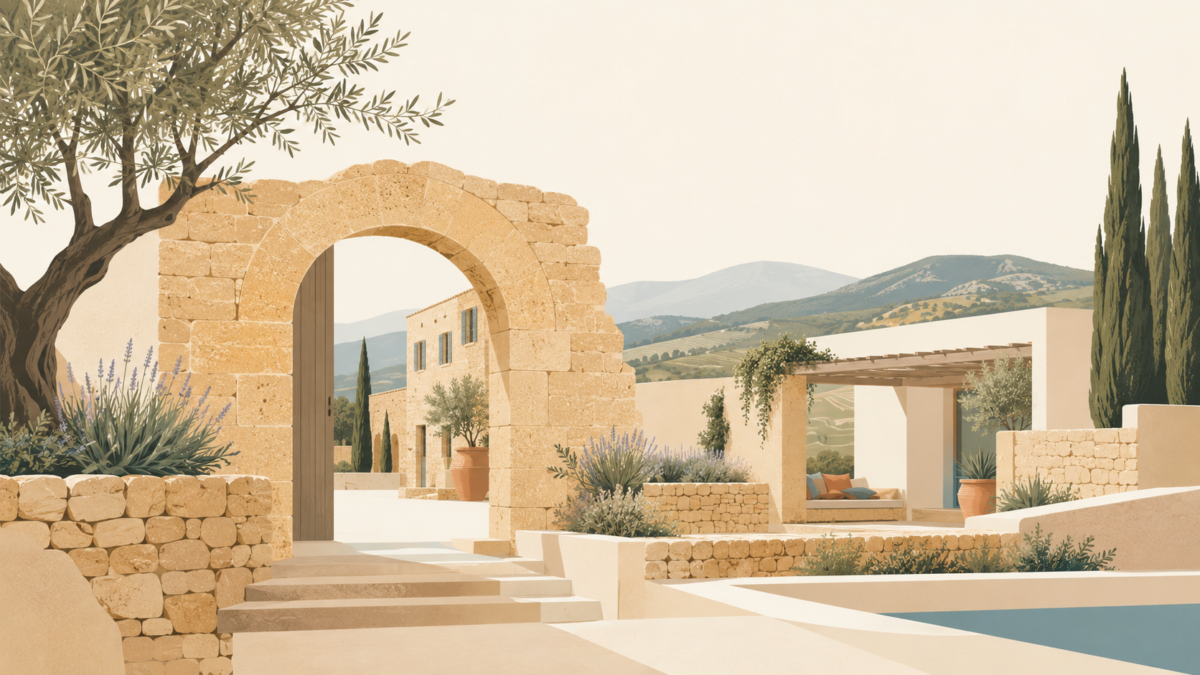
Renovating Historic and Rural Properties in Mallorca


Author: Klaudia Wolf Reviewed by Matthias Thomas
Renovating an old finca, village house, or historic townhouse in Mallorca is rarely a pure interior fit-out project. It usually first involves substance, moisture, roof, legal certainty, and the question of which parts of the building can be altered at all.
Before Purchase: Check Technical and Legal Substance
Check land register, cadastre, actual areas, previous building permits, usage status, municipal planning, classification as suelo urbano or suelo rústico, protected areas, catalog protection, BIC status, or surroundings protection of a monument. The technical check should include moisture analysis, roof inspection, load-bearing walls and ceilings, cracks, wooden beams, foundations, installations, wastewater solution, water source, access, and terrain modeling.
Old Building Fabric Requires Different Solutions
Many traditional houses consist of natural stone masonry, Marès stone, lime mortar, wooden beams, ceramic bricks, and historic plaster systems. These components must be able to absorb and release moisture. Dense cement plasters, hard joints, plastic paints, or internal waterproofing without a building physics concept can trap moisture and later cause salts, spalling, odor, or structural damage.
For historic fabric, lime-based mortars, diffusion-open plasters, compatible natural stone repairs, reversible installation routes, and well-ventilated constructions are usually the better basis. Modern materials are not excluded, but must be compatible with the old fabric and any protection level.
Moisture, Roof, and Structure
Moisture arises from rising damp, driving rain, leaking roofs, missing drainage, hillside water, poor ventilation, defective cisterns, or dense new floor slabs. Before plastering or insulating, the cause should be investigated. The roof is almost always an early large cost item: wooden beams, supports, deflections, tile covering, connections, and moisture traces should be inspected before purchase.
Heritage Protection, Catalog Protection, and BIC
Properties may be protected as Bien de Interés Cultural, as bienes catalogados, part of a historic ensemble, or via a municipal catalog. Interventions may require prior approval from the Comisión Insular del Patrimonio Histórico, in addition to the municipal building permit. Depending on the protection level, this affects not only facades but also interiors, stairs, vaults, roofs, courtyards, wells, mills, or ethnological elements.
Permits and Energy
Depending on the municipality and project scope, licencia urbanística, comunicación previa, or declaración responsable may apply. For structural interventions, roof renovation, change of use, extension, pool, facade alteration, or protected elements, a technical project is usually required. The Código Técnico de la Edificación generally also applies to interventions in existing buildings, but allows justified flexibility for protected buildings if strict requirements would be incompatible with the protection value.
Costs and Timelines
| Project Type | Orientation | Note |
|---|---|---|
| Technical Due Diligence | approx. 1,500-6,000 EUR | Depending on size, protection status, and scope of report |
| Targeted Repairs | approx. 600-1,200 EUR/m² | Without complete reorganization |
| Comprehensive Renovation | approx. 1,500-2,800 EUR/m² | Roof, installations, bathrooms, floors, and moisture |
| Historic Finca with Structure, Roof, and Systems | approx. 2,500-4,000+ EUR/m² | Higher with difficult access, protection requirements, or high-quality finishes |
| Reserve | 15-30 % | More a necessity than a luxury with old fabric |
Permits can take several months for simple municipal projects; with Patrimonio, suelo rústico, protected areas, or legalization issues, twelve months or more are not uncommon. Construction time for comprehensive finca renovations is often twelve to twenty-four months.
- Check protection status and catalog entry with the municipality and Consell.
- Assess the urbanistic legality of each building element individually.
- Have roof, moisture, structure, and installations technically inspected before purchase.
- Coordinate material concept with lime, natural stone, wood, ceramic, and diffusion openness.
- In the purchase contract, regulate conditions for license, legalization, or negative reports.
Frequently asked questions
What does it cost to renovate an old finca in Mallorca?
As a guide, expect around EUR 600 to 1,200/m² for targeted repairs, around EUR 1,500 to 2,800/m² for a comprehensive renovation and around EUR 2,500 to 4,000+/m² for a historic finca with structure, roof and services. With difficult access, protection requirements or high-end fit-out, it can be higher. A technical due diligence costs roughly EUR 1,500 to 6,000, depending on size, protection status and scope of the report.
How long does it take to renovate a finca in Mallorca?
Construction time for comprehensive finca renovations is often twelve to twenty-four months. Permits can take several months even for simple urban projects. With patrimonio, suelo rústico, protected areas or legalisation issues, twelve months or more is not unusual.
What permits do you need to renovate an old building in Mallorca?
Depending on the municipality and scope of the project, a licencia urbanística, comunicación previa or declaración responsable may be required. For structural work, roof renovation, change of use, extension, pool, facade changes or protected elements, a technical project is regularly required.
What does heritage protection mean for a property in Mallorca?
Properties can be protected as a Bien de Interés Cultural, as bienes catalogados, as part of a historic ensemble or through a municipal catalogue. Works may require prior approval from the Comisión Insular del Patrimonio Histórico, in addition to the municipal building permit. Depending on the level of protection, this also affects interiors, staircases, vaults, roofs, courtyards, wells or mills.
Which materials are suitable for renovating historic houses in Mallorca?
Lime-based mortars, vapour-permeable plasters, compatible natural stone repairs, reversible installation routes and well-ventilated constructions are usually the better basis. Dense cement renders, hard pointing, plastic paints or interior sealing without a building physics concept can trap moisture and later cause salts, spalling or structural damage.
What should you check before buying a house in need of renovation in Mallorca?
You should check the land register, cadastre, actual areas, earlier building permits, use status, municipal planning, classification as suelo urbano or rústico and protection status. The technical check covers damp analysis, roof inspection, load-bearing walls and ceilings, timber beams, installations, wastewater solution, water source and access. The purchase contract should provide for conditions covering a licence, legalisation or negative reports.
Sources
- Ley 12/2017, de urbanismo de las Illes Balears Boletín Oficial del Estado
- Ley 6/1997, del Suelo Rústico de las Illes Balears Boletín Oficial del Estado
- Plan Territorial Insular de Mallorca Consell de Mallorca
- Mapa Urbanístic de les Illes Balears (MUIB) Govern de les Illes Balears
- Ley 12/1998 del Patrimonio Histórico de las Illes Balears Boletín Oficial del Estado
- Patrimonio histórico Consell de Mallorca
- Código Técnico de la Edificación: ámbito de aplicación Código Técnico de la Edificación
- Real Decreto 390/2021 sobre certificación de eficiencia energética Boletín Oficial del Estado
- Costes de la construcción tipo en las Illes Balears, 2026 / PEM calculator COAIB