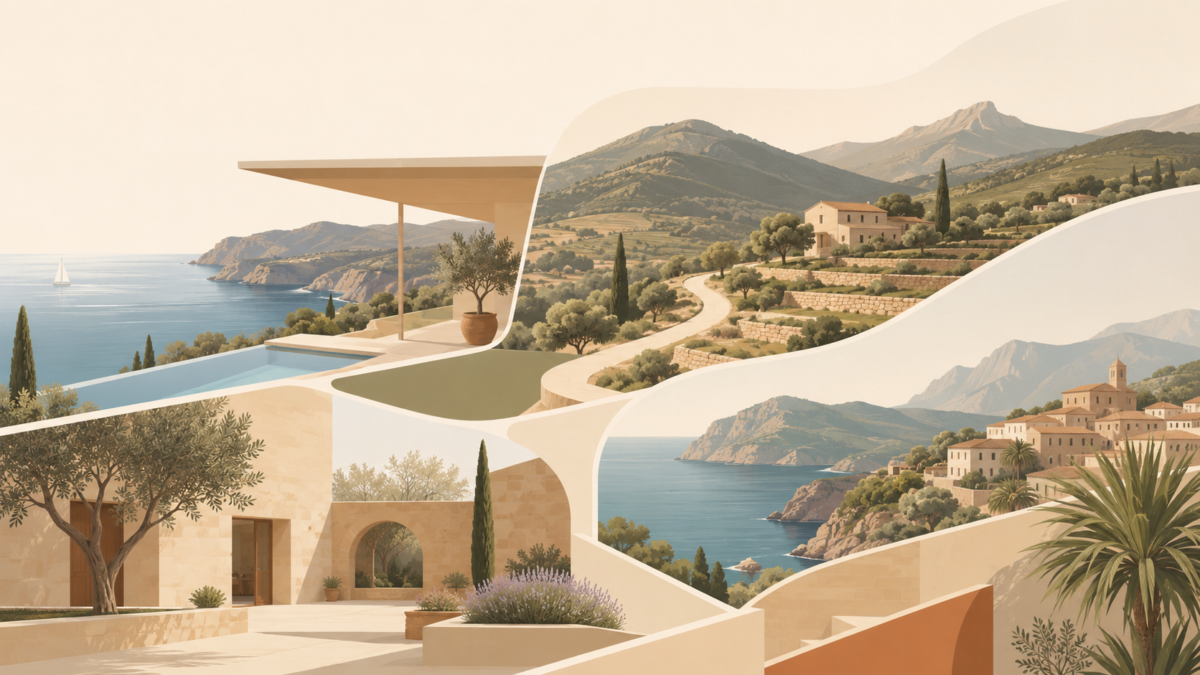
Regions of Mallorca Compared


Author: Klaudia Wolf Reviewed by Matthias Thomas
The choice of region when buying property in Mallorca is often more important than the choice of property type. A villa with sea views, a townhouse in Palma, a finca in the interior, and an apartment in a harbor location can all be high-quality properties, but they follow completely different everyday logics: accessibility, microclimate, infrastructure, privacy, tourist dynamics, buildability, maintenance effort, and resale value differ significantly.
This guide helps you answer the question of which region fundamentally suits your lifestyle and your purchase goal. For specific places and current properties, you will find a dedicated page for each region.
Why the region is so decisive for buying property in Mallorca
Mallorca is small enough to seem manageable, but large enough that everyday life and property quality vary greatly by region. Palma, Son Vida, and the southwest particularly benefit from short airport connections and year-round infrastructure. Palma de Mallorca Airport closed 2025 with around 33.8 million passengers according to Aena; this international accessibility is a key reason why second homes and premium properties in Mallorca remain so liquid.
At the same time, Mallorca is not a homogeneous market. The Balearic Islands continue to be among the most expensive real estate markets in Spain; according to INE, residential property prices there were 13.7% above the previous year in Q2 2026. For buyers, this means: a lower price per square meter is not automatically a better purchase, and a high price is not automatically justified. What matters is whether micro-location, property quality, legality, infrastructure, and resale value align.
Understanding the regions of Mallorca
On a real estate level, Mallorca is rarely understood solely by administrative boundaries. Buyers tend to think in location worlds: Palma and Son Vida, Southwest, Tramuntana and West Coast, North, Northeast and East, Southeast, and Inland. This division is pragmatic because it better describes how everyday life, property supply, and demand actually feel.
Palma and Son Vida
Palma de Mallorca is the most urban location on the island: historic old town, international gastronomy, culture, medical care, schools, port, airport access, and year-round life are all close together. Anyone who wants to live on Mallorca not just for holidays but regularly or permanently almost always considers Palma. Son Vida complements this logic in the luxury segment: villa-like residential areas, golf, privacy, and quick access to the capital.
Southwest
The southwest is one of the most international and liquid real estate regions in Mallorca. Places like Port d'Andratx, Camp de Mar, Santa Ponca, Costa d'en Blanes, El Toro, Peguera, Sant Elm, and S'Arracó stand for sea views, harbors, short distances to Palma, international buyers, and a broad spectrum from apartments to premium villas. The region is particularly strong when yachting, sea views, good infrastructure, and resale value play a major role.
West and Tramuntana
The Serra de Tramuntana is not an ordinary residential area, but a cultural landscape with special protection and identity value. UNESCO describes the Tramuntana as a centuries-old terraced, water, and dry-stone landscape. For buyers, this means: exceptional landscape, strong emotional quality, and great discretion, but also more challenging access routes, stricter building regulations, higher inspection requirements, and fewer standardized comparison values.
North
The north around the Bay of Alcúdia and the Formentor peninsula is often appreciated by buyers who want to combine beaches, family use, holiday home logic, and scenic expanse. Can Picafort is an example of an accessible coastal location with proximity to the beach and tourist infrastructure. In upscale northern locations, the search can become very granular because micro-locations, sea views, wind conditions, and seasonal operations vary greatly.
Northeast and East
The east and northeast often feel quieter than the southwest and can be interesting for buyers seeking more land, more distance, and a less glamorous environment. Typical are fincas, country houses, village houses, and selected coastal locations. The region can be attractive if the goal is not maximum international visibility, but a balanced ratio of tranquility, nature, space, and price level.
Southeast
The southeast is strongly perceived through lifestyle, coves, designer fincas, and a summer coastal logic. Places around Santanyí, Cala d'Or, and the southeastern coves appeal to buyers who want to combine Mediterranean atmosphere, markets, restaurants, beaches, and finca character. The region can be very high-quality, but depending on the location, it is more seasonal than Palma or the southwest.
Inland
The inland is interesting for buyers who do not primarily define Mallorca by sea views. Santa Maria del Camí is an example of wine villages, country houses, fincas, larger plots, and good accessibility. Those seeking year-round tranquility, privacy, authenticity, and space quality often find more convincing answers inland than directly on the coast.
Which location suits which lifestyle?
The right region arises less from an abstract ranking than from usage and everyday life. A holiday home for multiple generations needs different qualities than a discreet primary residence, a yacht-oriented villa, or an apartment for regular short stays.
- City life and year-round infrastructure: Palma, Son Vida, and well-connected suburbs are strong when restaurants, culture, medical care, schools, airport, and daily life should be within short distance.
- Sea views and premium location: Southwestern coastal locations and selected hillside locations are often the first choice when views, international demand, and resale value are important.
- Yachting: Port d'Andratx, Port Adriano, Puerto Portals, and Palma are particularly relevant when harbor infrastructure and short distance to the boat are decisive for the purchase.
- Families: Proximity to Palma, Santa Ponca, El Toro, Son Vida, and well-developed coastal towns offer advantages in schools, sports, medical care, and everyday suitability.
- Tranquility and nature: Tramuntana, inland, parts of the north, and the east are suitable for buyers who prioritize distance, landscape, and discretion over maximum proximity to Palma.
- Finca and country living: Inland, southeast, east, and selected Tramuntana locations are obvious, but require particularly careful inspection of access, water, electricity, legality, and usage.
- Holiday use: Coastal locations, places with good gastronomy and beaches, and well-connected regions are practical. However, possible rental must be legally examined separately.
- Investment and resale: Very liquid locations with international demand, good infrastructure, and clear property quality are usually more resilient than seemingly cheap square meter prices in weaker micro-locations.
- Discretion and privacy: Son Vida, selected hillside locations, Tramuntana properties, and large inland plots can be suitable, provided access, neighborhood, and legal status are right.
Regional buyer profiles
The following profiles are not fixed rules, but they help focus the search and avoid early wrong decisions.
Southwest: Premium, sea views, and international demand
The southwest suits buyers who desire sea views, harbor life, international neighborhood, good restaurants, and short distances to Palma. The region is particularly relevant for premium and luxury properties, second homes, discreet search mandates, and buyers who consider later resale. The downside: good locations are scarce, price levels are high, and compromises on micro-location or property condition quickly become expensive.
Palma and Son Vida: Urbanity, luxury, and year-round living
Palma is suitable for buyers who do not see Mallorca merely as a holiday destination. Those who value everyday life, culture, medical care, gastronomy, schools, and short airport distances find the highest density of year-round infrastructure here. Son Vida is the exclusive complement for buyers who want to combine proximity to the city, villa, privacy, and prestige.
West and Tramuntana: Nature, character, and discretion
The Tramuntana is ideal for buyers seeking landscape, authenticity, and architectural character. Historic houses, stone fincas, and hillside locations can be exceptional, but are rarely simple purchases. Access, monument protection, renovation, humidity, water, property boundaries, and building legality should be examined particularly carefully.
North: Families, holiday homes, and coastal expanse
The north is suitable for buyers seeking beach proximity, family use, and a more relaxed holiday home logic. Around the bays, harbors, and historic towns, very different sub-markets emerge. The region can be strong for families and seasonal use, but should be differentiated by micro-location, wind, seasonal operation, and accessibility.
Northeast and East: Tranquility, fincas, and space
These locations suit buyers seeking more space and less international density. Fincas, village houses, and country houses can offer good value for money if location, legality, and infrastructure are right. Those who need to commute to Palma daily or seek maximum liquidity should soberly assess travel times and demand breadth.
Southeast: Coves, design, and Mediterranean lifestyle
The southeast appeals to buyers who want to combine beaches, weekly markets, restaurants, finca architecture, and design. It is emotionally strong but can be more seasonal. For holiday homes and high-quality fincas, it is interesting; for year-round living, one should concretely check infrastructure, schools, medical care, and winter operation.
Inland: Country living, vineyards, and larger plots
The inland is ideal for buyers seeking privacy, plot size, landscape, and authentic village life. Proximity to Palma is often better than many expect depending on the location. However, sea views, beach proximity, and tourist infrastructure are not the main arguments. Decisive are access, plot quality, water, building status, and the question of whether inland living truly fits everyday life.
Regional comparison as a decision table
| Region | Suitable for | Typical property types | Price level | Advantages | Possible limitations | Suitable places |
|---|---|---|---|---|---|---|
| Southwest | Premium buyers, yachting, sea views, second home | high to very high | international demand, infrastructure, resale | scarce supply, high prices, strong micro-location differences | ||
| Palma & Son Vida | year-round living, city, luxury, families, short distances | medium to very high | infrastructure, culture, medical care, airport, everyday suitability | less tranquility, parking and density in city locations, very high prices in top locations | ||
| West / Tramuntana | Nature, historic properties, discretion, collector's items | medium to very high | landscape quality, character, privacy | access, protection status, renovation, legality and comparability | ||
| North | Families, holiday homes, beach proximity, relaxed coastal locations | medium to high | beaches, expanse, family use, holiday quality | seasonality, wind and micro-locations, longer distances to Palma | ||
| Northeast / East | Tranquility, finca, space, value-for-money search | medium to upscale | more space, less density, authentic places | travel times, lower market liquidity, infrastructure depending on location | check according to search profile | |
| Southeast | Lifestyle, coves, design, holiday home, finca | medium to high | Mediterranean atmosphere, beaches, markets, architecture | seasonality, legal checks for country houses, longer distances to Palma | check according to search profile | |
| Inland | Country living, vineyards, larger plots, privacy | medium to high | plot quality, tranquility, authenticity, sometimes good Palma connection | no coastal feel, especially check water/access/legality |
What buyers should consider in every region
Regardless of the region, the micro-location often decides in Mallorca. Two properties in the same place can have completely different qualities: view, noise, hillside location, access, sunlight, neighborhood, building condition, humidity, water, electricity, internet, parking, and legal documentation are not interchangeable.
Especially with fincas, rural estates, historic buildings, and first sea line, the regional decision should always be combined with a technical and legal inspection. Cadastre, land registry, cédula, energy certificate, possible protected areas, coastline, flood risk, water availability, and building law status are not formalities but purchase-deciding factors.
How to use this regional comparison
Do not start with the question of which place is "the best." A short priority list is more useful: How often will you be in Mallorca? Should the property function year-round? How important are sea views, privacy, airport time, schools, harbors, restaurants, rentability, and resale? From these answers, a sensible search corridor usually emerges very quickly.
If you want to compare specific places, use the linked detail pages for the individual regions. The guide page helps with strategic preselection; the location pages then help with offers, micro-location, and specific properties.
Frequently asked questions
Which region in Mallorca is best for a villa with sea views?
The south-west, with places such as Port Andratx, Camp de Mar, Costa d'en Blanes, El Toro, Peguera and Sant Elm, stands for sea views, harbours, short distances to Palma and international buyers. The downside: good locations are scarce, price levels are high to very high, and compromises on micro-location or condition quickly become expensive.
Where can you live year-round in Mallorca?
Palma offers the highest density of year-round infrastructure, with its old town, restaurants, culture, healthcare, schools, harbour and airport connections. Son Vida complements this in the luxury segment with villa locations, golf and privacy. Outside these areas, you should check infrastructure, schools, healthcare and winter operation in concrete terms.
Where can you find fincas and country houses in Mallorca?
The obvious choices are the centre of the island, the south-east, the east and selected locations in the Tramuntana. Fincas require particularly careful checking of access, water, electricity, legality and use. The centre of the island suits buyers who are looking for privacy, larger plots and authentic village life, but not primarily sea views.
What should you bear in mind when buying property in the Serra de Tramuntana?
The Tramuntana is a cultural landscape with special protection and identity value. Buyers find exceptional scenery and plenty of discretion there, but must expect more demanding access roads, stricter building constraints, higher due diligence requirements and fewer standardised comparables. Access, heritage protection, renovation, damp, water and structural legality should be checked particularly carefully.
Which places in Mallorca suit yacht owners and families?
For yachting, Port Andratx, Port Adriano, Puerto Portals and Palma are particularly relevant when harbour infrastructure and a short distance to the boat are decisive for the purchase. For families, proximity to Palma, Santa Ponsa, El Toro, Son Vida and well-developed coastal towns offer advantages in schools, sport and healthcare. Any possible holiday letting must be reviewed separately from a legal standpoint.
How do you choose the right region for a property in Mallorca?
Start with a short list of priorities rather than the question of the best place. Clarify how often you are in Mallorca, whether the property should work year-round and how important sea view, privacy, airport travel time, schools, harbours, lettability and resale are. Regardless of region, micro-location often decides, because two properties in the same town can have completely different qualities.
Sources
- El Aeropuerto de Palma de Mallorca cierra 2025 con 33,8 millones de pasajeros Aena
- Cifras oficiales de población de los municipios españoles: Revisión del Padrón Municipal Instituto Nacional de Estadística (INE)
- Cultural Landscape of the Serra de Tramuntana UNESCO World Heritage Centre
- Plan Hidrológico de las Illes Balears 2022-2027 Govern de les Illes Balears
- Acceso a la información catastral Dirección General del Catastro
- Sistema Nacional de Cartografía de Zonas Inundables MITECO
- Líneas de deslinde para el Dominio Público Marítimo Terrestre MITECO